The sweet side of sustainability: uncovering LCA insights with SimaPro

Chocolate might seem like a simple indulgence. But behind every bar lies a complex supply chain that spans continents, ingredients, and processes. To explore how life cycle assessment (LCA) software can make sense of that complexity and turn it into actionable insight, we modelled a simplified comparison study of dark and milk chocolate bars, using SimaPro desktop edition and the ecoinvent database. This article exemplifies how teams can translate results into practical business decisions.
Setting up a credible study
As with any meaningful LCA, the process started by defining the goal and scope. The objective was a like-for-like comparison of a dark and a milk chocolate bar produced in Switzerland, modeled as a cradle-to-gate study. We defined the system boundaries to include ingredient production, chocolate manufacturing, transport, and packaging, including the end-of-life of the packaging.
Even for a hypothetical study, grounding it in realistic assumptions mattered. By selecting a Swiss factory and using Swiss electricity datasets, the model reflected a credible local energy mix. For sugar, we chose beet sugar, which is commonly used in European chocolate production, rather than cane sugar, which is more typical in other regions. These methodological choices helped ensure that differences in results could be attributed to the products themselves, rather than to inconsistent assumptions.
The study also included the packaging, a mix of cardboard and aluminum foil, modelled through its full life cycle. It was important to understand not just what went into the chocolate, but how the final product was wrapped and delivered.
From concept to model using SimaPro
With the scope defined, the next step was to build the model in SimaPro. The process began by selecting materials and processes from the ecoinvent database — cocoa beans, sugar, milk, packaging materials — and adapting them where needed. When a perfect dataset didn’t exist, we created proxies from related unit processes, documenting each assumption to keep the study transparent.
The flexibility of SimaPro desktop proved key. We could adjust datasets to reflect specific regions or energy mixes, ensuring the model aligned with the Swiss production context. The software’s transparency also allowed us to look beneath the surface, exploring how each dataset contributed to the overall impact.
Once the inventory was complete, the Network view mapped where impacts originated within each product system. Thicker lines in the network diagram immediately revealed hotspots, such as the cocoa production stage.
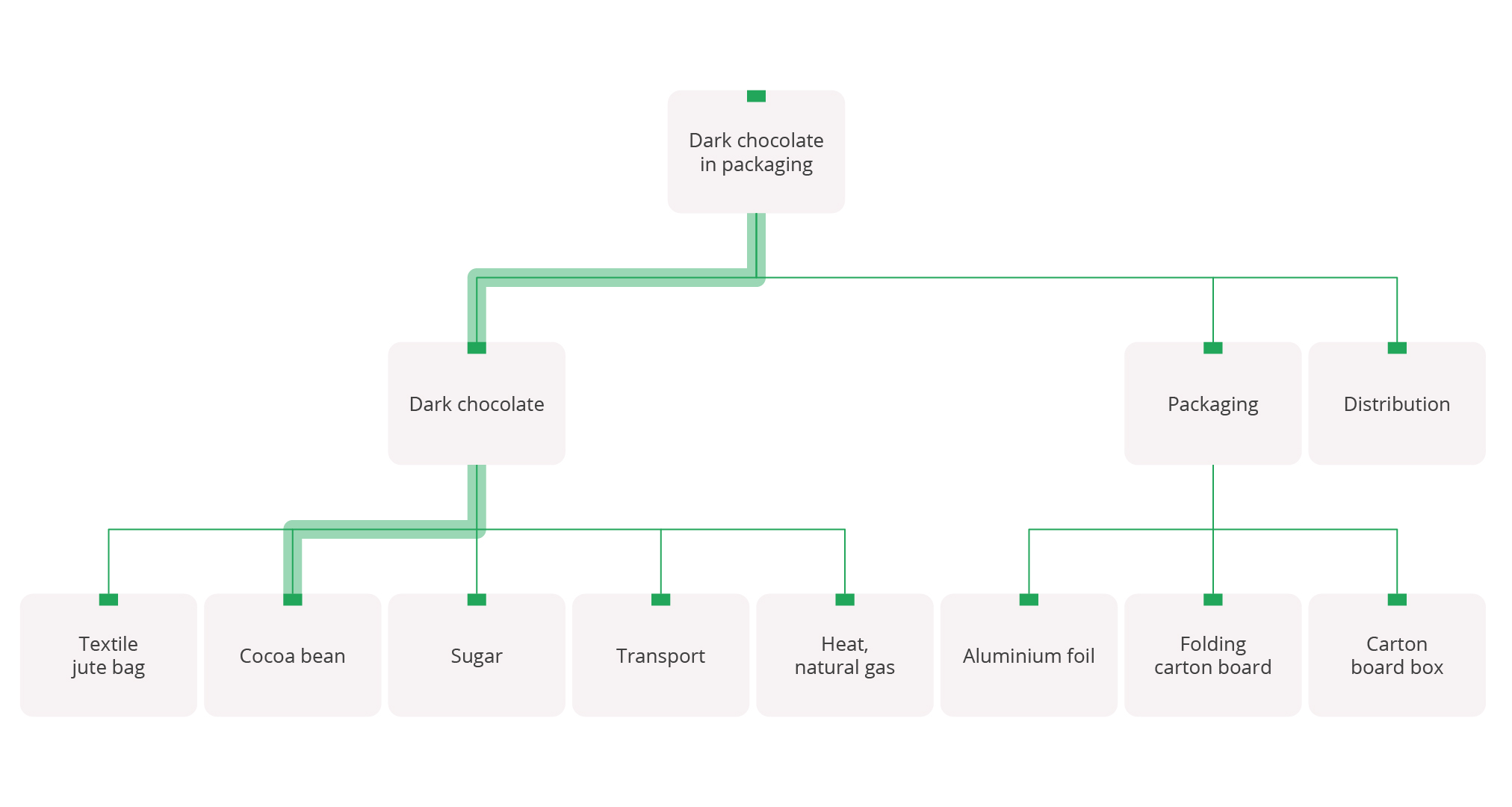 Network view of LCA model for dark chocolate example
The comparative view went a step further, allowing us to place the two products side by side and visualize differences across impact categories.
And with the Report Maker, we exported results into Excel to generate clear visuals that could be easily updated as assumptions evolved; an efficient way to keep non-LCA stakeholders engaged without repeating manual work.
What the results revealed
For deeper and more relevant insights, SimaPro desktop allows us to use analysis groups to organize results by life cycle stages: raw materials, transport, production, distribution, and end-of-life.
Looking at our case study, SimaPro confirmed that ingredients dominate the environmental footprint of chocolate. Cocoa, in particular, emerged as the primary driver across all impact categories. Milk powder, while impactful, played a smaller role than expected. In contrast, transport — often perceived as a major contributor — turned out to be relatively minor in this case.
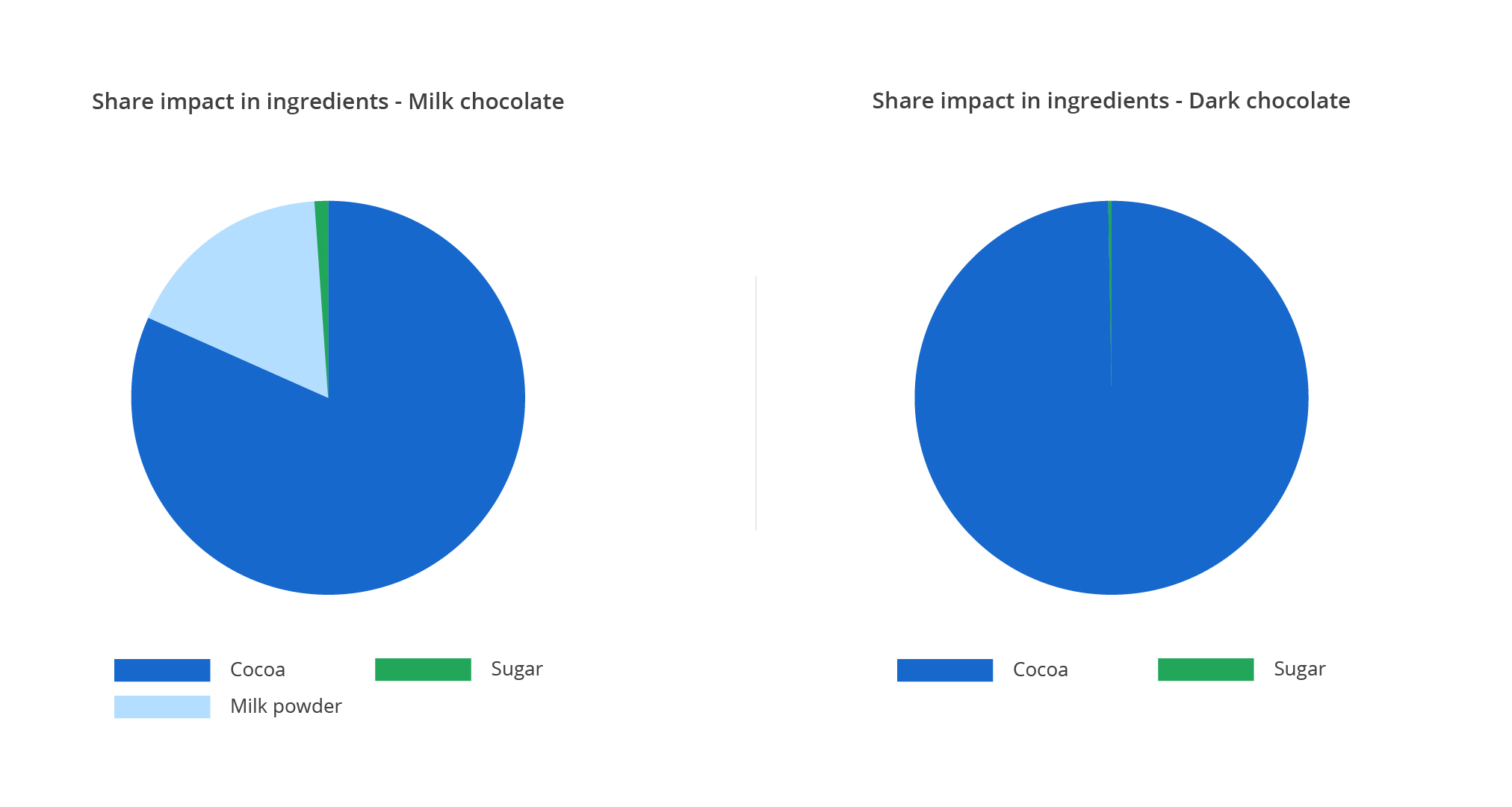 Share impact in ingredients for milk vs dark chocolate – carbon footprint
Packaging was another surprise. Though not the main contributor, it still accounted for a few percentage points of total impact, with cardboard playing a larger role than aluminum foil in the carbon footprint.
In short, ingredient sourcing overshadowed every other stage. This finding underscores how critical it is for food companies to understand their supply chains and raw material choices. Key decisions, such as selecting certified, deforestation-free cocoa or local sugar sources, can have a measurable effect on a product’s environmental performance.
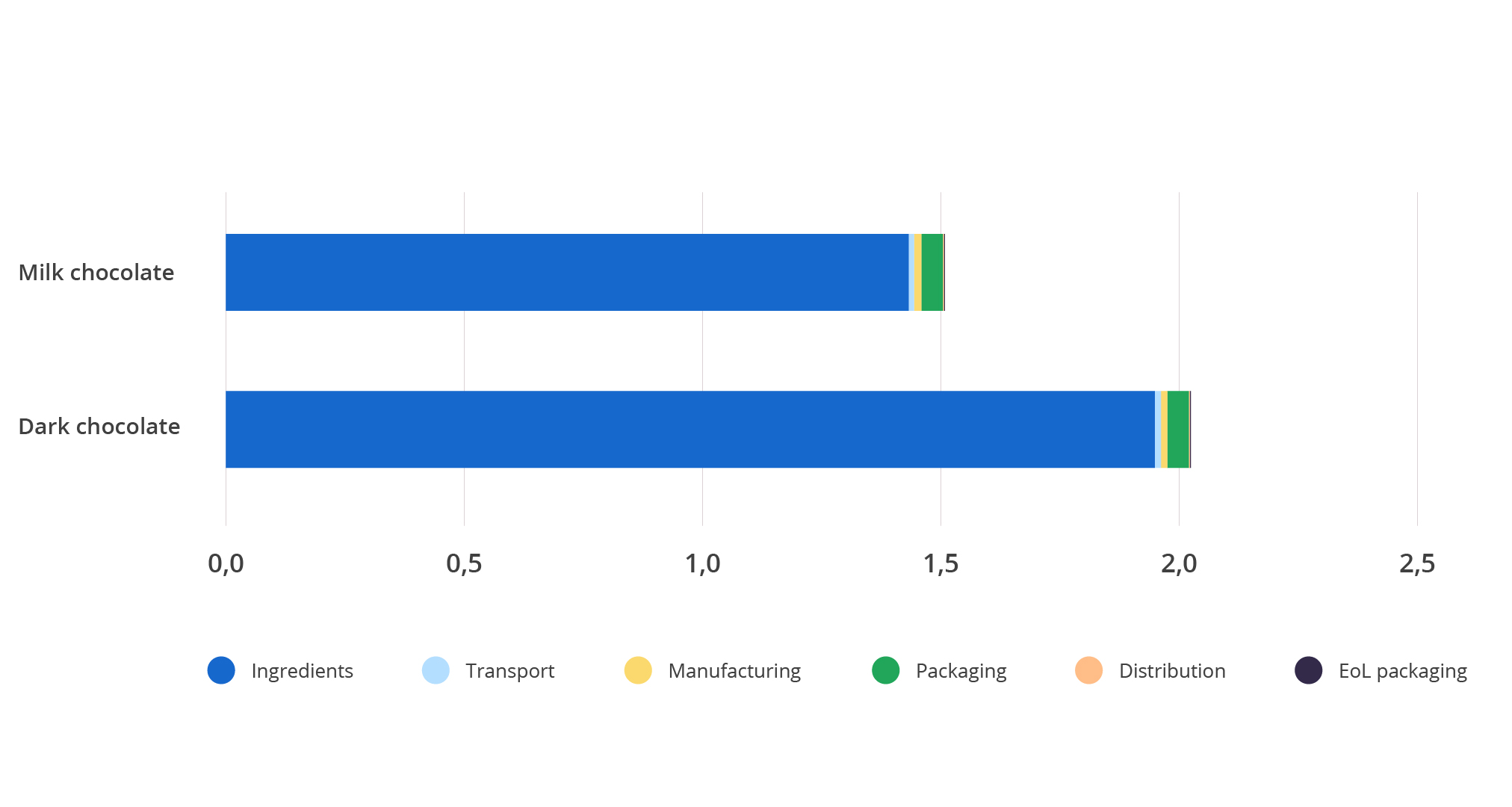 Comparison of impact across life cycle stages
From insight to action
Beyond the technical modelling, the real value of LCA lies in interpretation, in how the results are used. In this study, the findings could guide several parts of a business, for example:
- Product development teams could use the model to test new recipes, experimenting with the cocoa percentage or exploring plant-based milk alternatives.
- Procurement could use the same insights to evaluate suppliers and sourcing regions, focusing on where the footprint truly matters.
- Packaging teams could explore materials and end-of-life scenarios to confirm which design changes would meaningfully reduce impact and which might not.
- For leadership, the results serve as a decision-making tool rather than a scientific report. The goal isn’t to showcase every methodological detail, but to translate technical findings into clear business actions: which processes to optimize, which ingredients to rethink, and where investments in sustainability will have the greatest return.
SimaPro desktop supports this translation. Its parameter-based modelling makes it easy to rerun scenarios and see how results shift when assumptions change. With Report Maker, updated results feed directly into dashboards or Excel reports, keeping sustainability insights dynamic and relevant.
Scaling up and moving forward
Traditionally, companies treated LCA as a project: conduct a study, publish a report, and move on. But with software like SimaPro, LCA can become a scalable process — integrated into regular decision-making. Parameters and reusable models make it possible to assess multiple product variations with minimal additional effort.
The future lies in linking company data systems directly with LCA tools. Energy use, ingredient quantities, or transport distances already live in enterprise systems; connecting those datasets to LCA models would allow automated updates, reducing manual data collection and keeping sustainability insights in step with business reality.
Start where you are
For companies just beginning with LCA, the key is to start practical rather than perfect. A rough model using secondary data already highlights the biggest impact areas. From there, data collection can focus where it matters most, and the model can gradually evolve with more detail and accuracy. That granularity is what turns an LCA from a static exercise into a living, adaptable model. As companies gather better data or shift suppliers, the model can evolve, making LCA a continuous improvement tool rather than a one-off report.
As the chocolate study showed, even a simplified model can raise valuable questions, shape smarter decisions, and uncover opportunities that align environmental and business performance.
If you’d like to see how these insights can apply to your own products, we’d love to explore that together.
Apply these insights to your own products
Want to uncover hotspots and turn sustainability data into real decisions? See how SimaPro helps you model, analyze, and improve product impacts with confidence.