Life cycle assessment (LCA) glossary
Life cycle assessment (LCA) uses a wide range of technical terms, methods, and acronyms that can be challenging to navigate, especially as the field continues to evolve. This glossary brings together clear, concise definitions of commonly used LCA terminology to help you get started as well as keep up with the sustainability conversation.

Acidification
Acidification relates to the increase of acid content in land or oceans. This increase can kill bacteria, algae and other micro-organisms necessary for ecological balance. It can also reduce plant growth and dissolve the shells and skeletons of oceanic species such as corals and oysters.
Allocation
In LCA, allocation is the division of input or output flows over different products or supply chains. Two types of allocation are important:
- Multi-output allocation
- End-of-life allocation
Multi-output allocation is used when a process produces more than one output product i.e., co-products. In that case, you have to allocate the environmental impacts of the process across the produced output products. For example, in a sawmill, the logs are converted into planks, sawdust and bark. Thus, you have to allocate the environmental impact of the sawmill process across the planks, sawdust and bark.
In the case of end-of-life allocation, you specify if the burdens and credits of the waste treatment go to the supply chain creating the waste or the one using it. For example, a PET bottle is recycled into PET granules that are used as input into the production of a jacket. End-of-life allocation then specifies if the burdens and credits of the recycling process go to the PET bottle supply chain or to the jacket supply chain.
Background processes
A background process is a process of your life cycle for which you do not have direct information. Examples can be the production of electricity or incineration of plastics.
Bill of materials (BOM)
A bill of materials (BOM), or sometimes product structure or associated list, is a list of the raw materials, sub-assemblies, intermediate assemblies, sub-components, parts and the quantities of each needed to manufacture the product. This BOM provides the basis for the life cycle inventory (LCI).
Category endpoint
An attribute or aspect of natural environment, human health, or resources, identifying an environmental issue of concern (ISO 14040). The impact on such an endpoint can be quantified with Life Cycle Impact Assessment (LCIA). An example of an endpoint is the effect on ecosystems.
Characterization
Characterization is the second step in your Life Cycle Impact Assessment (LCIA). It quantifies the impact a product or service has on each impact category. This is based on the elementary flows of the product. These elementary flows can have a different magnitude of impact on impact categories. This impact intensity (i.e. the potency) is expressed with characterization factors. This step is mandatory per ISO 14040/14044.
Characterization factor (CF)
Characterization factors are used in characterization to quantify the magnitude of impacts observed along cause-effect pathways, in the reference unit of their category. The higher the effect of an elementary flow on an impact category, the higher the characterization factor. Characterization factors are derived from a characterization model and are given by the Life Cycle Impact Assessment (LCIA) method.
Classification
The first step of the Life Cycle Impact Assessment (LCIA) where connections between elementary flows and specific impact categories are made. This involves sorting flows into classes according to the effect they have on the environment. This step is mandatory per ISO 14040/14044.
Climate change
One of the more well-known impact categories. It considers the inputs and outputs that result in greenhouse gas emissions. Consequences of climate change are increased average global temperatures and sudden regional climate changes. The results are often expressed in the reference flow kg CO2 eq.
Company-specific data
Directly measured or collected data for the activities in the life cycle. It is the same as primary data and the opposite of data for a background process.
Cradle to gate
A partial product supply chain, from raw materials extraction (cradle) up to the manufacturer’s “gate”. This includes all relevant inputs and outputs of raw material extraction and processing. The distribution, storage, use stage and end of life stages of the supply chain are excluded.
Cradle to grave
A full product’s life cycle, from raw material extraction (cradle) to treatment of the product at end of life (grave). This includes all relevant inputs and outputs for all of the stages of the life cycle: raw material extraction, processing, distribution, storage, use, and disposal or recycling stages.
Disability adjusted life years (DALY)
The disability-adjusted life year (DALY) is a measure of overall disease burden, expressed as the number of years lost due to ill-health, disability or early death. It was developed as a way of comparing the overall health and life expectancy of different countries. Human health categories often report in DALY.
ecoinvent
ecoinvent is a not-for-profit association based in Switzerland. They provide a very extensive and widely used life cycle inventory (LCI) database with thousands of products. These well-documented datasets can be used to model background processes in your own LCA.
Ecotoxicity
An impact category that considers the toxic impacts on an ecosystem. It is a result of different toxicological mechanisms. Consequences are damaged individual species and changes in structure and function of the ecosystem.
This can happen in freshwater, marine or terrestrial ecosystems.
Elementary flows
A material or energy flow entering the system being studied that has been drawn from the environment without previous human transformation. Or a material or energy flow leaving the system being studied that is released into the environment without subsequent human transformation. (ISO 14040, 2006). Examples are direct use of river water and emissions of carbon dioxide into air.
End of life
This is the last life cycle stage of your product under study. It describes the faith after the product is used. It can include landfilling, incineration, recycling and open dumping.
Endpoint
An attribute or aspect of natural environment, human health, or resources, identifying an environmental issue of concern (ISO 14040). The impact on such an endpoint can be quantified with Life Cycle Impact Assessment (LCIA). An example of an endpoint is the effect on ecosystems.
Endpoint method
An endpoint method looks at the end of the cause-effect chain. They involve more complex modelling and introduce greater uncertainty, but are easier to interpret compared to a midpoint.
Environmental footprint method
This is an Life Cycle Impact Assessment (LCIA) developed by the European Commission (EC). It is used to calculate the Organization and Product Environmental Footprint. It contains multiple impact categories.
Environmental Product Declarations (EPD)
An Environmental Product Declaration (EPD) is an independently verified and registered document that communicates transparent and comparable information about the life-cycle environmental impact of products in a credible way.
Eutrophication
An impact category that addresses the impact of excessive nutrient flows. This can happen in freshwater, marine or terrestrial ecosystems where it has different consequences. In freshwater ecosystems, it can, for example, cause algal bloom and oxygen deficiency leading to fish death.
Foreground processes
A process in the life cycle for which you have direct information. This is the opposite of background processes. Data for this is also called company-specific data.
Functional unit (FU)
The functional unit (FU) defines qualitative and quantitative aspects of the function provided by the evaluated product. When comparing two or more products this FU is the basis for the comparison. The amount of a product needed to fulfil the FU is the reference flow.
An example of a functional unit for paint is: 20 m3 wall completely covered with paint for a period of 30 years.
Gate to gate
A partial product supply chain that includes only the processes carried out on a product within a specific organization or site.
Gate to grave
A partial product supply chain that includes all relevant inputs and outputs for the distribution, storage, use, and disposal or recycling stages.
Hotspot
A life cycle stage, process or elementary flow which has a high contribution to the environmental impact. In the PEF methodology all life cycle stages, processes or elementary flows that cumulatively contribute to more than 80% are defined as hotspot.
Human toxicity
An impact category that accounts for the adverse health effects on human beings by the intake of toxic substances. This intake can be through inhalation, food/water ingestion and penetration through the skin. There is often a category for effects related to cancer and one related to non-cancer.
Impact categories/ indicators
An impact category groups emissions of different flows into one effect on the environment.
Impact categories include for instance global warming, ozone depletion, acidification of soil and water, eutrophication, human toxicity, fresh water aquatic ecotoxicity. PRé has a series of articles explaining the lesser-known impact categories:
Ionizing radiation
An impact category that accounts for the effects of high energy radiation. This can interact with and change molecules and damage or kill cells. Examples of sources include nuclear power generation and medical devices for diagnosis.
IPCC method
The IPCC method is a Life Cycle Impact Assessment (LCIA) method only covering the climate change impact category. It is based on scientific consensus.
It is used in most of the LCIA methods that report on climate change.
ISO 14040:2006
An international standard that covers life cycle assessment (LCA) studies and life cycle inventory (LCI) studies. An LCA study can be reviewed according to the ISO 14040 and ISO 14044 standards making the results more trustworthy. The difference between the two documents is that ISO 14040 provides a general introduction to the principles of LCA and LCI. By contrast, ISO 14044 sets out specific requirements.
ISO 14044:2006
An international standard that covers life cycle assessment (LCA) studies and life cycle inventory (LCI) studies. An LCA study can be reviewed according to the ISO 14040 and ISO 14044 standards, making the results more trustworthy. The difference between the two documents is that ISO 14040 provides a general introduction to the principles of LCA and LCI. By contrast, ISO 14044 sets out specific requirements.
Land use
An impact category related to use (occupation) and conversion (transformation) of land area. The effects of land use, the area involved and the duration of the occupation are taken into account in land occupation.
Land transformation includes the changes in land properties for that area. This can, for example, include emissions of CO2 from the vegetation and soil when a forest is transformed into an industrial area.
Life cycle
All stages of a product system, these are consecutive and interlinked and go from raw material to disposal. This is sometimes called a supply-chain.
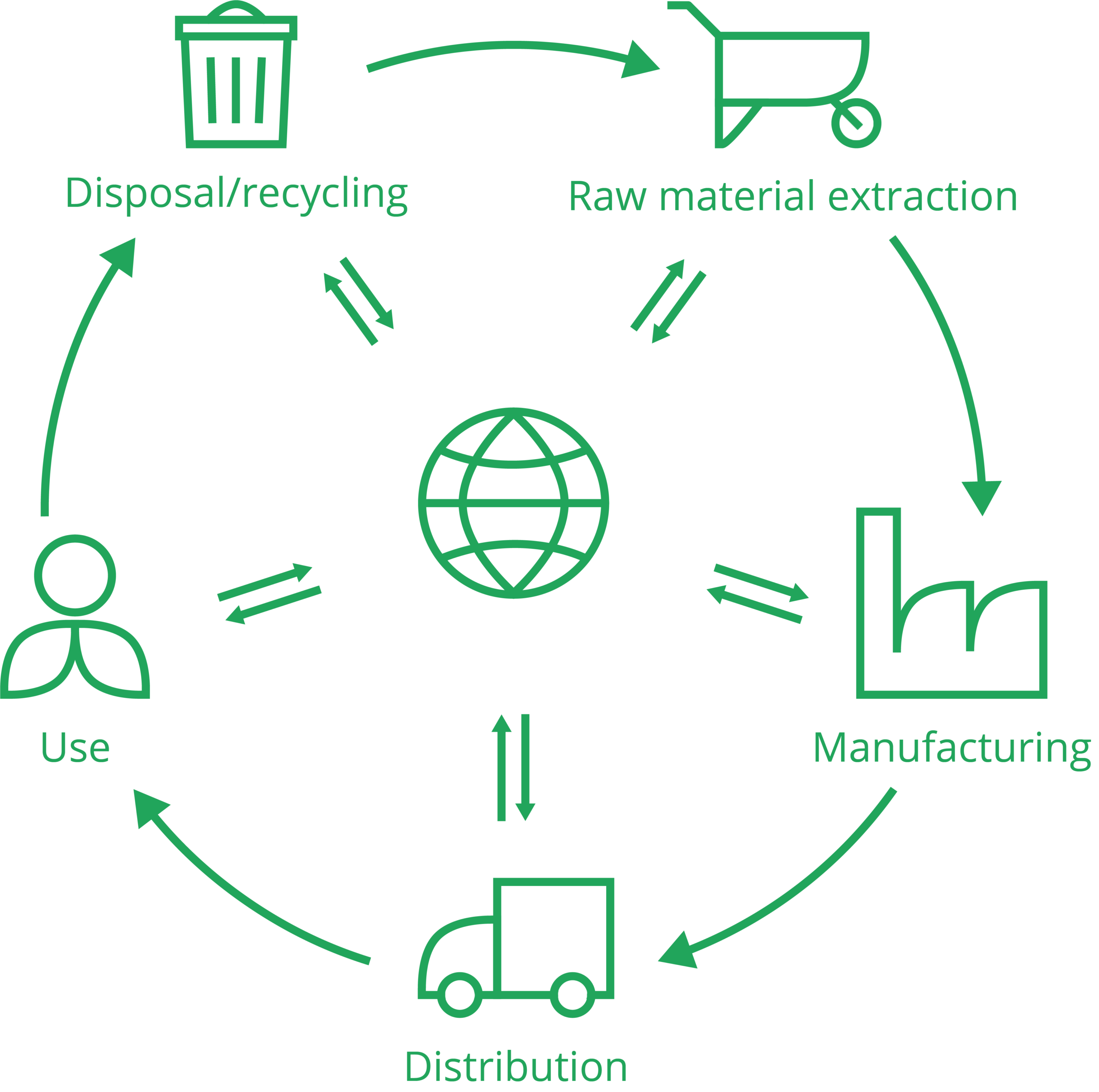
The life cycle stages
Life Cycle Costing (LCC)
LCC is an economic approach that sums up ”total costs of a product, process or activity discounted over its lifetime”. It is associated with cost in general rather than just environmental costs.
Life Cycle Assessment (LCA)
Life cycle assessment (LCA) is a methodology for assessing environmental impacts associated with all the stages of the life cycle of a commercial product, process, or service. LCA studies the environmental aspects and potential impacts throughout a product’s life cycle (i.e. cradle-to-grave) from raw materials acquisition through production, use and disposal.
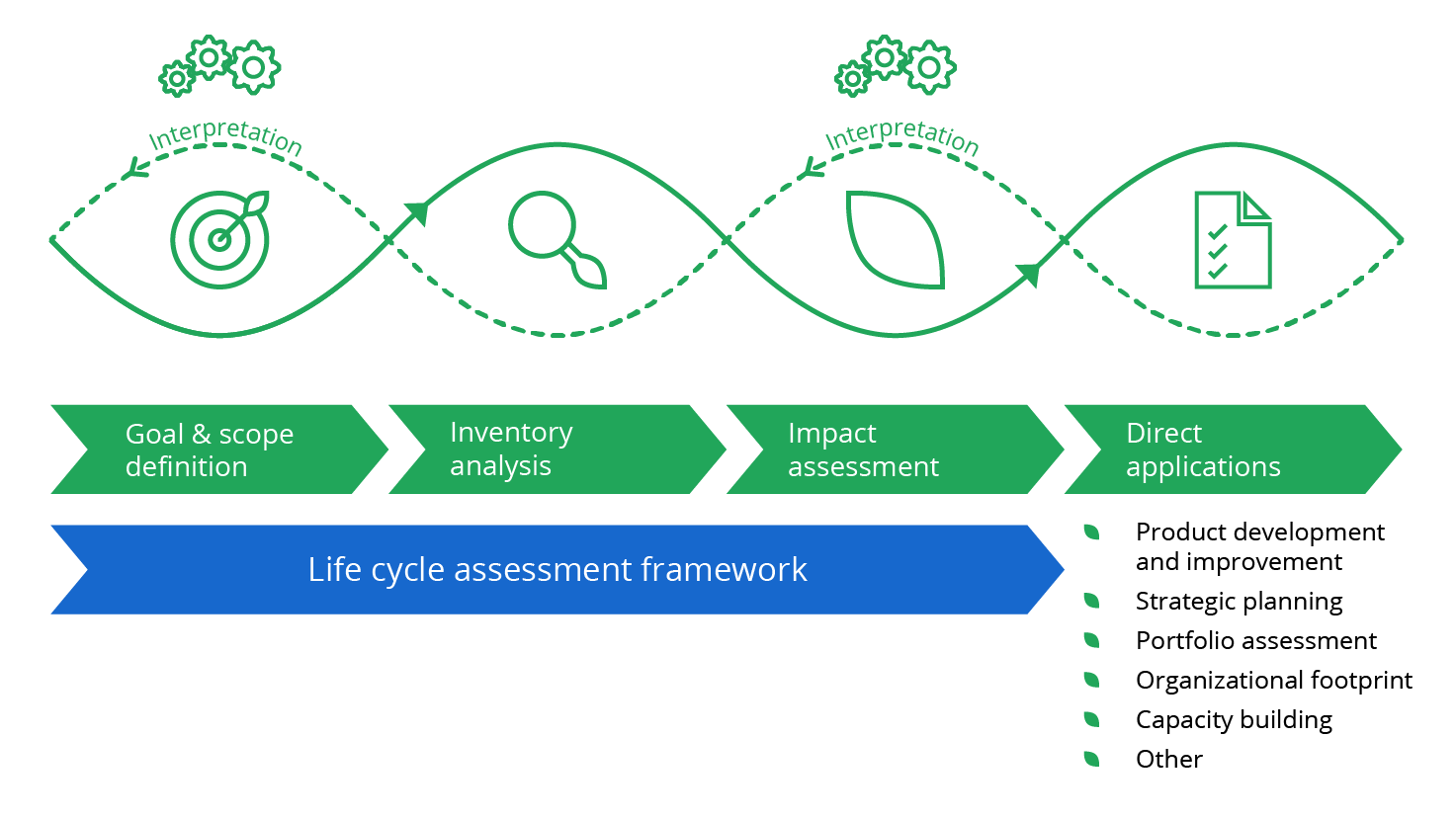
The iterative framework of LCA
Life Cycle Impact Assessment (LCIA)
The phase of the Life Cycle Assessment (LCA) that aims to quantify the potential environmental impact of the life cycle by translating Life Cycle Inventory (LCI) results into tangible environmental insights.
This consists of four steps:
- Classification
- Characterization
- Normalization
- Weighting
Life Cycle Impact Assessment method
This is used in the Life Cycle Impact Assessment to categorize and quantify various effects by providing characterization factors, and often (but not always) normalization and weighting factors. These factors are based on models.
Methods can differ in covering one or multiple impact categories (single or multi-issue), covering midpoint and/or endpoint indicators and which characterization models are used in the background.
A few well-known methods are ReCiPe, Environmental Footprint method and IPCC method.
Life Cycle Inventory (LCI)
All inputs and outputs into a process or life cycle. It can be one long list of elementary flows. This is used as input into the Life Cycle Impact Assessment.
Life Cycle Management (LCM)
Life cycle management is a product management system aiming to minimize environmental and socio- economic burdens associated with an organization’s product or product portfolio during its entire life cycle and across its value chain. LCM is not a single tool or methodology, but a management system collecting, structuring and disseminating product- related information from various programs, concepts, and tools.
Midpoint
An indicator that is somewhere along the environmental mechanism and the LCI parameter. For instance, ReCiPe calculates 18 midpoint indicators and 3 endpoint indicators. Midpoint indicators focus on single environmental problems, for example climate change or acidification. Endpoint indicators show the environmental impact on three higher aggregation levels, being the 1) effect on human health, 2) biodiversity and 3) resource scarcity.
Midpoints are typically more certain and less complex, but they can be harder to interpret compared to endpoints.
Monte Carlo
Monte Carlo analysis is a numerical way to process uncertainty data and establish an uncertainty range in the calculated results.
In the Monte Carlo approach, the computer takes a random variable for each value within the uncertainty range specified and recalculates the results. The result is stored. Next the calculation is repeated by taking different samples within the uncertainty range, and the results are also stored. This is repeated until a sufficient number of results are formed to provide a measure of the spread of calculated results. The set of results form an uncertainty distribution.
Normalization
Normalization is the third step in Life Cycle Impact Assessment (LCIA), after classification and characterization. Characterized results have different units. One way to ease the interpretation of such scores is to normalize them: dividing your scores by a reference situation’s scores. This reference situation could be one person’s (“average Joe”) resource use and emissions released in the world during one year. Normalization converts complicated units into fractions of this average person’s scores per impact category.
This step is optional per ISO 14040/14044.
Normalization factors
Normalization factors are used to do normalization. Normalization factors can for example be the average emissions per person. These factors are given in some Life Cycle Impact Assessment (LCIA) methods.
Organizational Environmental Footprint (OEF)
A standardized methodology from the European Commission on how to calculate the environmental impact of an organization. The PEF and OEF are the EU recommended Life Cycle Assessment (LCA) based methods to quantify the environmental impacts of products (goods or services) and organizations.
Particulate matter formation
An impact category accounting for the negative effects on human health caused by the emissions of particulate matter and elements that can form particulate matter in the atmosphere such as NOx.
Photochemical ozone formation
Sometimes called ozone formation. An impact category that accounts for the formation of ozone caused by, for example, oxidation of volatile organic compounds. High concentrations of ozone can damage vegetation, human respiratory tracts and manmade materials as it can react with organic materials.
Primary data
Sometimes also called company-specific or foreground data. Data specific to the processes from the analyzed life cycle.
Product Category Rules (PCR)
Product Category Rules are a set of rules, requirements and guidelines for developing Environmental Product Declarations (EPD) for one or more product categories. Product Category Rules are created in collaboration with industry associations from a given sector.
Product Environmental Footprint (PEF)
A standardized methodology from the European Commission on how to calculate the environmental impact of a product. The PEF and OEF are the EU recommended Life Cycle Assessment (LCA) based methods to quantify the environmental impacts of products (goods or services) and organizations.
With PEF results in hand, you can inform consumers and customers about the environmental performance of your products. Because the methodology is standardized, the results are credible and based on sector consensus.
At PRé, developer of SimaPro, we can carry out PEF studies as well as help you build your own PEF capacity so you can create future product environmental footprints independently.
Product Environmental Footprint Category Rules (PEFCR)
Product Environmental Footprint Category Rules (PEFCRs) and Organization Environmental Footprint Sector Rules (OEFSRs) can be used for calculating the Environmental Footprint profile for products and organizations. The PEFCR makes sure that the environmental impact of two products is calculated based on the same methodology and thus comparable.
ReCiPe
ReCiPe is a method for the life cycle impact assessment (LCIA), containing multiple impact categories. It was first developed in 2008 and updated in 2016. ReCiPe2016 was developed in collaboration between the Dutch National Institute for Public Health and the Environment (RIVM), Radboud University Nijmegen, Norwegian University of Science and Technology, and PRé.
Reference flow (RF)
The amount of a product needed to fulfil the functional unit.
Reference unit
A reference unit is used for an impact category to be able to express all impacts of flows in the same unit.
For example, the reference unit for climate change is carbon dioxide equivalent (CO2 eq). Climate change is caused by greenhouse gases (GHGs). To be able to assess their impacts on climate change, all emissions are converted into the equivalent amount of CO2 that would cause the same level of warming.
Resource scarcity/ use
An impact category that addresses the use of non-reneable rsources. Often split in fossil natural resources (e.g. coal, oil) and mineral and metals.
Secondary data
Data that is not from the specific supply chain, this data is not directly collected. It is the same as background data.
Single score
Weighting LCA results can create a single score. The weighted results all have the same unit and can be added up to create one single score for the environmental impact of a product or scenario.
This can ease the interpretation but it is very important to be aware of the value judgement applied when doing this.
Social life cycle assessment (S-LCA)
Social life cycle assessment (S-LCa or social LCA) is a method that can be used to assess the social and sociological aspects of products, their actual and potential positive as well as negative impacts along the life cycle.
Stratospheric ozone depletion
Sometimes also called ozone depletion. An impact category covering the adverse effect of ozone depletion on human health, plant growth, marine food chains and biogeochemical cycles.
System boundary
Definition of aspects included or excluded from the study. For a cradle-to-grave study, the system boundary includes all activities from raw materials extraction to disposal.
System process
A process containing only elementary flows and no links to other processes in the model. Using this improves the calculation speed but lowers the transparency of the model.
Unit process
A process containing links to other processes in the model. Using this decreases the calculation speed but increases the transparency of the model.
Water consumption
An impact category representing the use of water by the product. In some methods this is included as water scarcity, taking into account the abundance of water in the region.
Weighting
Weighting is an optional final step in Life Cycle Impact Assessment (LCIA), after classification, characterization and normalization. Weighting entails multiplying the normalized results of each of the impact categories with a weighting factor that expresses the relative importance of the impact category. This perceived relative importance introduces a subjectiveness to your study.
This step is not permitted for comparisons per ISO 14040/14044.
Weighting factor
A factor that is coupled to a certain impact category, which is often determined by a panel, based on subjective opinions. The factor reflects the perceived relative importance of the category.