Understanding the ReCiPe impact assessment method
When conducting a life cycle assessment (LCA), the long list of emissions and resource flows from your life cycle inventory needs to be translated into environmental impacts. That’s where life cycle impact assessment (LCIA) methods come in. One of the most widely used is ReCiPe, a method available in SimaPro.

ReCiPe helps LCA practitioners make sense of complex data by grouping impacts into two levels:
- 18 midpoint categories, such as global warming or water use
- 3 endpoint categories, which show how these issues affect human health, ecosystems, and resource availability
This approach balances scientific rigor with interpretability, though endpoint categories carry more uncertainty. Users can also choose from three cultural perspectives—individualist, hierarchist, and egalitarian—each reflecting different assumptions about time horizons and the required level of evidence. The hierarchist perspective, rooted in scientific consensus, is most commonly applied. You might also consider analyzing the other two perspectives to evaluate how sensitive the results are to your choice, as part of a sensitivity analysis.
ReCiPe was created in collaboration between the Dutch National Institute for Public Health and the Environment (RIVM), Radboud University Nijmegen, Norwegian University of Science and Technology, and PRé, and remains one of the most established methods for global LCA studies. It continues to evolve to support practitioners in generating meaningful, science-based insights.
Would you like to explore ReCiPe in more detail and see how it compares to other methods such as Environmental Footprint (EF) and GLAM (Guidance for LCA indicators and Methods)? Read the full article on the PRé Sustainability website.
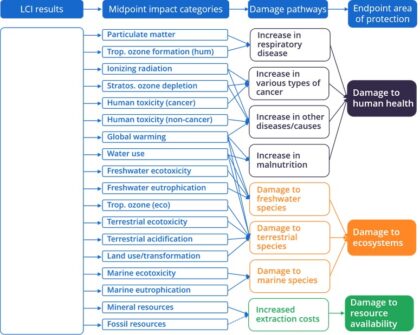
Framework of the ReCiPe method: Relationship between LCI results, midpoint impact category and endpoint impact categories