Moving beyond green claims in apparel and footwear

Apparel and footwear brands need to support environmental claims with stronger evidence. At the same time, many teams are becoming more careful about what they say due to anti-greenwashing rules.
In a recent webinar, Danai Mangana, Sustainability Consultant and Consumer Goods Sector Lead at PRé Sustainability, explained the market and regulatory pressure behind that shift. Pasquale Coppolella, independent consultant with deep experience in fashion operations and sustainability leadership, shared what data collection and supplier engagement look like inside brands. Emilie Carasso, Sustainability and Policy Director at 2B Policy, showed how life cycle assessment (LCA) and the Apparel and Footwear Product Environmental Footprint Category Rules (PEFCR) can help create more reliable product data.
The main takeaway: better sustainability communication starts with data that teams can trace, explain, and use across the portfolio.
Read below or watch the webinar recording to learn how apparel and fashion brands can avoid both greenwashing and greenhushing with credible sustainability data. Understand the advantages of life cycle assessment (LCA), the Apparel and Footwear Product Environmental Footprint Category Rules (PEFCR), and more consistent footprinting workflows.
Environmental claims are moving from story to proof
A few years ago, many apparel and footwear brands had a sustainability story. Claims multiplied and labels became more visible. For a time, that looked like progress, but then scrutiny caught up.
The European Commission found that 53% of green claims gave vague, misleading, or unfounded information, 40% had no supporting evidence, and half of green labels offered weak or no verification. It also identified 230 sustainability labels and 100 green energy labels in the EU, with very different levels of transparency.
Those findings helped trigger a stricter policy response. In the EU, the Directive on Empowering Consumers for the Green Transition will make vague environmental claims harder to use from September 2026. Generic claims such as “green” or “eco-friendly” will need recognized environmental performance data behind them, and sustainability labels will need to meet clearer credibility and verification requirements. At the same time, the Ecodesign for Sustainable Products Regulation (ESPR) and France’s environmental cost of clothing framework are pushing apparel and fashion brands toward more structured product-level data.
The result is not only stricter regulation: it is a harder communication environment. Brands are still expected to provide clearer environmental information, but every claim now needs stronger evidence behind it. As Danai Mangana put it: “The demand for credibility is rising, but demonstrating it is becoming more complex.”
Environmental communication in apparel and footwear is no longer only about what can be said on a label, campaign, or product page. It is becoming part of product data management, supplier engagement, regulatory readiness, and long-term brand trust.
From greenwashing to greenhushing
The webinar described a shift many sustainability teams will recognize: some brands are no longer overclaiming. They are saying less (or nothing at all), which is referred to as greenhushing. Danai described greenhushing as the flip side of greenwashing: companies are “actively decreasing their climate communications” to avoid scrutiny.
That silence may feel safer, especially when regulations are changing and data is incomplete. But it does not remove the underlying demand for credible information. Buyers, consumers, investors, and regulators still want to know how products perform. The question is how brands can communicate without relying on weak claims or waiting until every uncertainty disappears.
This is where product-level footprinting becomes practical. It gives teams a way to move from broad sustainability statements to evidence they can explain: what was measured, which method was used, which assumptions were made, and where data quality can improve.
Regulation is pushing product data into business planning
Even if individual rules are still evolving, the general direction is set.
The Ecodesign for Sustainable Products Regulation (ESPR) is now shaping product requirements in the EU, with technical preparation underway for Digital Product Passports (DPPs). The European Commission has started the preparatory work for product groups including textile apparel.
The Green Claims Directive proposal was tabled by the European Commission in June 2025, but that does not mean green claims scrutiny has disappeared. The broader direction remains toward more reliable, comparable, and verifiable environmental information, supported by existing consumer rules, national initiatives, and sector-specific methods.
France is moving faster. Its environmental cost of clothing framework, or coût environnemental, already applies to brands placing textile products on the French market. It sets the method for calculating and communicating the environmental cost of textile clothing products. For brands selling in France, this involves a practical risk: from October 2026, third parties may also publish scores where brands have not provided their own data, using publicly available information and default values.
These advances make environmental data more than a compliance topic. It becomes part of market readiness. Pasquale Coppolella said it plainly: “Transparency has moved from a regulatory matter to a business matter.”
The fragmented data and operational challenge
Inside brands, the pressure is not abstract. It lands on sustainability teams that need to collect data across departments, suppliers, and systems. Pasquale was direct when describing this reality: “Data collection is a nightmare.”
The challenge is partly technical, but not only. Product data may sit with design, sourcing, operations, logistics, or suppliers. Some suppliers are ready to provide structured data, but others need support to understand what is being asked, why it matters, and how to respond.
This creates a familiar tension: sustainability teams are asked to publish better information, but the information they need is often fragmented. Without clear ownership, data requests can feel like favors rather than part of a shared business process.
Pasquale also pointed to the cost of transparency: “Disclosure and transparency have a huge cost.” That cost is not only financial. It includes time, coordination, supplier engagement, and internal education. Brands that plan for this work early will be in a stronger position than those that treat each new request as a one-off exercise.
Why PEFCR matters for apparel and footwear
LCA gives brands a structured way to understand environmental impacts across a product’s life cycle. For apparel and footwear, the PEFCR gives that work a sector-specific foundation.
The Apparel and Footwear PEFCR is a science-based and impartial method to assess the environmental impact of clothing and shoes across their full life cycle, from raw material extraction, production, and distribution to use and end of life.
The PEF method helps the industry use harmonized calculation rules, evaluates products across 16 environmental indicators, and defines specific rules for 13 apparel and footwear categories. That specificity matters. Apparel and footwear products differ widely in materials, production, durability, repairability and end-of-life routes. A method that only looks at certain aspects of the product can miss part of the story.
Emilie Carasso, involved in the development of these PEFCR, explained one key choice when developing the rules: “We really wanted to make sure that we were covering a footprint for a single use, and not just for a product.”
This per-use logic helps account for quality, durability, repair, resale, and reuse. A product with higher production impact may perform differently when its impact is spread across more uses. That does not make footprinting simple, but it makes the question more relevant to how products are actually worn.
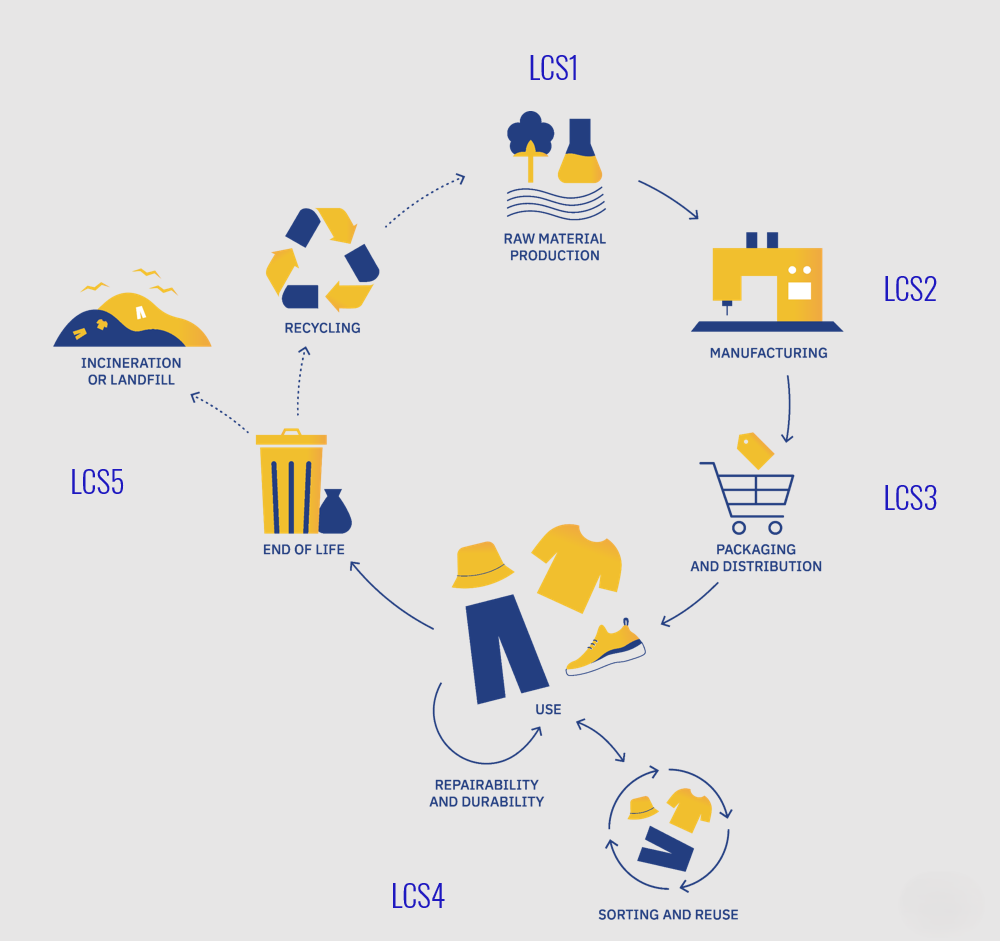 An illustration of apparel life cycle as covered by the PEFCR. Provided by 2B Policy
Better data does not mean collecting every datapoint
A credible footprint does not require every possible data point. It requires the right data points, handled consistently. Emilie made this distinction clearly: “The idea is to have a footprint that is representative of your product, but not necessarily collect every primary data point.”
That is an important message for brands. Data collection should focus on what drives the impact. Some information is hard to collect but has a major impact. Other information may be interesting but less material to the footprint. Harmonized methods and clear model structures help teams see the difference.
This is also where supplier engagement becomes essential. For apparel and footwear, key data may include exact product composition, material origin, manufacturing location, energy use, waste, and losses along the chain. Much of that sits outside the brand’s direct control.
Supplier education, shared expectations, and consistent templates can make data exchange less reactive. As Pasquale noted, the task is to make suppliers “feel part of a bigger picture.”
Portfolio-scale footprinting needs a repeatable process
One product LCA can answer one question. Apparel and footwear brands need to answer hundreds or thousands.
That is where many teams get stuck. Traditional LCA work can be slow, requires expertise, and is difficult to repeat consistently across collections, product categories, regions, and suppliers.
Danai summarized the scalability issue well: “One-off LCAs are never the answer when you need to substantiate claims across an entire portfolio.”
The challenge is not only the methodology. It is the process behind it: moving from a single assessment to something repeatable, traceable, and scalable.
SimaPro Compliance Packs for Apparel and Footwear were developed for this kind of work. The Apparel PEFCR Compliance Pack provides a PEFCR-aligned model, predefined system boundaries, datasets, calculation rules, ecoinvent v3.11 as the underlying database, and documentation explaining the model structure and methodological choices.
The Footwear PEFCR Compliance Pack applies a similar structure to footwear, including component-level modeling for complex products such as soles, uppers, linings, and packaging. It is designed to support consistent calculations across product lines and collections.
The goal is not to remove expert judgment. It is to give teams a structured foundation, so they can spend less time rebuilding models and more time improving data quality, interpreting results, and making better product decisions.
A more confident path forward for apparel and footwear
The next stage for fashion, apparel, footwear and textiles is not louder sustainability communication. It is communication backed by better data and systems.
Brands need to know which claims they want to make, which markets they need to prepare for, and which methods can support those claims. They need supplier data flows that work before a deadline arrives. And they need footprinting workflows that can scale across real portfolios, not just individual case studies.
Green claims will only become more credible when teams can provide the evidence behind them. LCA and PEFCR-aligned models provide a foundation. Scalable tools and clear processes make that foundation usable. The path ahead is not greenwashing or greenhushing, but defensible claims based on product data, built carefully enough to support communication, compliance, and better decisions.
Watch the full apparel & footwear webinar recording, or talk to our team about how to get started.
Apply these insights to your apparel & footwear products
Turn sustainability data into real decisions. See how SimaPro helps you model, analyze, and improve product impacts with confidence.