CFB-IND-aligned carbon footprints for industrial batteries
Generate audit-ready carbon footprints for rechargeable industrial batteries and prepare for EU Battery Regulation requirements, without building complex LCA models from scratch.
Why carbon footprint data matters for industrial batteries now
Industrial batteries are under growing regulatory and commercial scrutiny. Across Europe:
- The EU Battery Regulation requires carbon footprint declarations for rechargeable industrial batteries above 2 kWh, driving demand for standardized, verifiable data.
- The CFB-IND method (Rules for the calculation of the carbon footprint of industrial batteries without external storage), developed by the European Commission’s Joint Research Centre (JRC), sets out how these footprints should be calculated. Manufacturers, original equipment manufacturers (OEMs), and buyers are preparing their data accordingly.
- Custom-made (CM) and off-the-shelf (OtS) batteries, across chemistries such as lithium-ion, lead-acid, sodium-ion, and nickel-cadmium, all need to be assessed consistently.
This reflects a broader shift from ambition to accountability in the battery value chain. Without a standardized, scalable approach, responding to customer and regulatory data requests becomes slow, inconsistent, and hard to defend.
Getting this right means building a foundation of consistent, credible data so you can respond with confidence across your battery portfolio.
What the compliance pack delivers
Instead of building models from scratch, you get:
- A CFB-IND-aligned LCA model covering rechargeable industrial batteries above 2 kWh
- Predefined system boundaries, declared units, and calculation rules for repetitive energy supply (REP) and on-demand (OND) batteries, and for CM and OtS battery types
- Battery-specific recycling processes and the Circular Footprint Formula (CFF) built into the end-of-life stage
- Predefined datasets connected to secondary data from the latest ecoinvent version
- A flexible SimaPro model that users can adapt to their own products
- Documentation explaining the model structure and how to use it
You provide your battery and process data. The model applies a consistent structure, helping ensure results are aligned, comparable, and defensible.
What you can achieve with the compliance pack
- Respond to carbon footprint data requests with confidence
Generate standardized results aligned with CFB-IND. - Cover your full battery portfolio
Model REP and OND batteries, in both custom-made and off-the-shelf configurations, in one consistent framework. - Avoid rebuilding LCA models
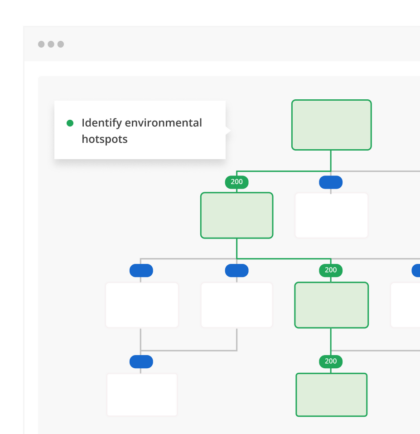
Skip months of interpreting the CFB-IND rules and setting up models manually. - Identify impact hotspots
See how raw materials, cell components such as the anode, cathode, and electrolyte, and cells, modules, and external units contribute to your battery’s footprint across manufacturing, distribution, and end-of-life recycling.

Why use this compliance pack
- Skip the “blank canvas” problem
No need to interpret CFB-IND rules or build aligned models from scratch. - Ensure consistency across battery types and teams
One standardized model avoids variation and rework across chemistries and configurations. - Be ready for audits and customer scrutiny
Transparent assumptions, predefined recycling scenarios, and documentation included. - Built on the EU’s methodology for battery carbon footprints
Aligned with the CFB-IND rules developed by the JRC to support Article 7 of the EU Battery Regulation
How it works
- Start with the CFB-IND-aligned model
- Configure the provided model to match your battery data, including materials, manufacturing, distribution, and end-of-life parameters
- Generate audit-ready carbon footprint results aligned with CFB-IND
Prepare for EU Battery Regulation requirements with confidence
Request a demo to see how you can generate CFB-IND-aligned carbon footprints across your battery portfolio.
