Request a demo to see how you can assess AI systems consistently and at scale.
ITU-T L.1801-aligned environmental footprints for AI systems
Generate audit-ready environmental footprints across the full life cycle of AI systems, without building complex LCA models from scratch.

Why environmental impact data for AI matters now
AI’s environmental footprint is under increasing scrutiny. Across the industry:
- Regulators, investors, and customers are asking for transparent, standardized environmental data on AI systems, covering both training and inference.
- ITU-T L.1801, published in February 2026, provides an international methodology for assessing the environmental impact of AI systems, including generative AI, large language models (LLMs), and inference deployments.
- Organizations that deploy or offer AI services are expected to report impacts by life cycle stage, such as training, deployment, inference, and continuous learning, rather than as a single aggregated number.
This reflects a broader shift from ambition to accountability for AI’s environmental impact. Without a standardized, scalable approach, responding to disclosure requests or customer due diligence becomes slow, inconsistent, and hard to defend.
Getting this right means building a foundation of consistent, credible data so you can report on any AI system or deployment with confidence.
What the compliance pack delivers
Instead of building models from scratch, you get:
- An ITU-T L.1801-aligned LCA model covering the full life cycle of an AI system, from raw materials and hardware production through training, inference, and end of life
- A functional unit based on tokens processed, with fractional hardware allocation that distributes training and infrastructure burdens across the system’s lifetime
- A life cycle stage structure that reports training, deployment and verification, inference, and continuous learning and re-evaluation separately
- Predefined datasets connected to secondary data from the latest ecoinvent version
- Documentation explaining the model structure and how to use it
- A flexible SimaPro model that users can adapt to their own systems
The model applies a consistent structure, helping ensure results are aligned, comparable, and defensible.
What you can achieve with the compliance pack
- Respond to environmental disclosure requests with confidence
Generate standardized results aligned with ITU-T L.1801. - Cover the full AI life cycle
Assess raw materials, hardware production, training, deployment, inference, continuous learning, and end of life in one framework. - Avoid rebuilding LCA models
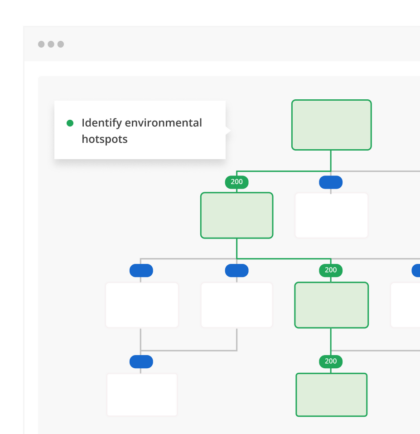
Skip months of interpreting the standard and setting up models manually. - Identify impact hotspots
See how hardware manufacturing, training energy, and ongoing inference contribute to your AI system’s footprint.

Why use this compliance pack
- Skip the “blank canvas” problem
No need to interpret ITU-T L.1801 or build aligned models from scratch. - Ensure consistency across systems and teams
One standardized model, functional unit, and allocation approach avoids variation and rework. - Be ready for audits and stakeholder scrutiny
Transparent assumptions, default values, and documentation included. - Built on an international standard
Aligned with ITU-T L.1801, which builds on the LCA method in ITU-T L.1410 and the enabling-effects method in ITU-T L.1480.
How it works
- Start with the ITU-T L.1801-aligned model
- Configure the provided model to match your AI system data, including hardware, training energy, and inference parameters
- Generate aligned results ready for reporting and disclosure
Meet ITU-T L.1801 expectations with confidence
