The hidden data debt in your sustainability reporting (and how to solve it)
When sustainability data is treated as an add-on rather than a strategic asset, it accumulates a hidden cost: data debt. Over time, this debt fragments systems, duplicates effort, and erodes trust. Technology leaders who address it early reduce risk and build smarter infrastructure.

You can’t manage what you can’t integrate.
As IT leaders scale their digital strategies, sustainability data is becoming part of the picture, but most stacks weren’t built for it. Scattered spreadsheets, siloed product data, and carbon calculators with opaque methods add up to a growing problem: data debt.
This hidden burden not only slows reporting, but also undermines traceability, credibility, and operational resilience. And without addressing it, sustainability remains stuck in pilot mode.
Why your tech stack is creating blind spots
Enterprise Resource Planning (ERP) systems, Product Lifecycle Management (PLM) systems, and Excel workbooks all have their role. But none were designed with sustainability in mind.
Sustainability data often lives in parallel systems – or worse, it’s pulled into spreadsheets for one-off Life Cycle Assessments (LCAs). The result: fragmented ownership, inconsistent datasets, duplicated entries, and limited audit trails.
Four warning signs of data debt in sustainability
These warning signs are symptoms of deeper system strain – places where digital infrastructure is failing to support sustainability efforts:
- Reliance on manual, expert-led LCAs that can’t scale beyond a handful of products
- Inconsistent or mismatched datasets across business units and suppliers
- Vendor lock-in with tools that don’t integrate or expose data lineage
- No version control or traceability of metrics shared with internal or external stakeholders
Together, these signs indicate rising risk for compliance, decision-making, and operational efficiency. And they might remain hidden until audit pressure or business scaling exposes the cracks.
The cumulative cost of inaction
As sustainability demands grow, from regulatory scrutiny to customer expectations, organizations that lack integrated, traceable data may find it harder to act or prove progress.
IT leaders are uniquely positioned to fix this, not just by deploying new tools, but by realigning how sustainability data fits into the broader architecture.
What a connected architecture looks like
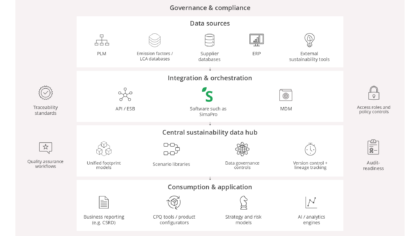
The components of a connected architecture
To address data debt, organizations need a systems-level foundation, one that connects sustainability to the enterprise stack, rather than sitting beside it.
A future-ready sustainability setup shares key traits with enterprise data platforms:
- Open APIs for seamless integration with PLM, ERP, and data lakes
- Centralized footprint models and datasets maintained with quality assurance
- Scalable workflows to support teams across product lines and geographies
- Transparent data lineage that shows exactly where numbers come from
Sustainability tools should act as an orchestration layer, not a silo. One example of a platform designed with these principles is SimaPro cloud. It provides a central space for managing sustainability models, enabling teams to work with traceable data that integrates into existing IT environments. Some organizations are already taking this approach, embedding sustainability into product development processes and replacing fragmented assessments with connected systems. It fits into enterprise ecosystems by focusing on openness and reusability.
To begin reducing data debt, IT leaders can start with a diagnostic to assess where the architecture supports sustainability, and where it needs work. For example:
- Where is your sustainability data stored today?
- Who maintains it, and how?
- Can you audit or trace key metrics back to source?
- What systems are duplicating effort or breaking governance?
Is your sustainability data helping or hindering progress?
Data debt can accumulate quietly, until it slows progress or undermines trust. By addressing integration early, IT leaders can help their organizations move from fragmented reporting to strategic decision-making.
Looking to reduce complexity and improve data reliability?
Contact us to discuss how your sustainability workflows could evolve.