Make LCA scalable and actionable without sacrificing quality
As sustainability becomes a business priority, many organizations are moving beyond one-off assessments. They’re aiming to scale life cycle assessment (LCA) across full product portfolios and supply chains. For LCA experts, this brings opportunity and complexity. The question isn’t whether to scale but how to do it without losing quality, agility, or alignment.

Why scaling LCA often stalls
LCA is a powerful methodology – it’s comprehensive, science-based and essential for credible sustainability reporting. But in practice, scaling it often introduces complexity rather than clarity.
What starts as a robust, well-defined study can spiral into:
- Fragmented data stored across teams, suppliers, or systems
- Time-consuming data transformation and verification
- One-off LCA models with limited reusability
- Results that don’t resonate with non-LCA experts or decision-makers
LCA practitioners spend more time collecting and cleaning data, and running the LCA calculations than interpreting it. And even when insights are generated, they often remain siloed, missing the agility to shape product design, procurement, or strategy.
A better path: configurable LCA models
The solution lies in building models designed for flexibility and scale.
Configurable models let LCA experts reuse core structures across product lines or production sites by changing inputs without rebuilding from scratch. This approach offers faster updates when data or methods change and consistent modeling logic, ultimately improving comparability. Rather than reinventing the wheel for each assessment, configurable models create a solid, scalable foundation that is ready to grow with the business.
What is a configurable LCA model?
Traditional models are typically built one product at a time. That becomes inefficient when scaling across hundreds or thousands of products. Configurable LCA models offer an alternative approach that makes LCA more scalable. Rather than modeling every product individually, a configurable LCA model represents a product category, service, or company using configurable processes and parameters.
For example, imagine a single model that accommodates both a regular bike and an e-bike. The e-bike may include an aluminum frame, while the regular bike uses steel. These differences—materials, component weights, and other variables—can be adjusted dynamically within the same model. This makes it possible to run accurate, product-specific assessments using one consistent framework. The result is a more scalable, maintainable, and future-proof way to assess environmental impacts across a wide range of products without duplicating effort.
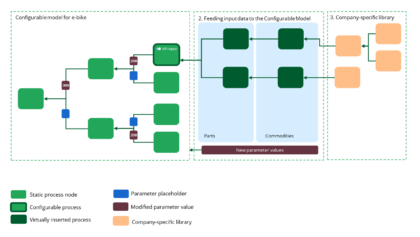
An illustration of a configurable LCA model that is enriched with input data via API
Bringing it to life with SimaPro cloud
Scaling LCA is not just a modeling challenge but a data challenge. Data lives in procurement systems, environmental databases, and internal spreadsheets. Collecting and consolidating the data is slow, error-prone, and hard to sustain at scale.
SimaPro cloud streamlines data handling by automating the flow of information from business systems into configurable models. Data is collected and processed in a middleware layer, then passed into SimaPro cloud via API connections. LCA experts develop the configurable models, setting the structure, parameters, and data mappings, while internal IT teams ensure SimaPro cloud connects to the right data sources.
This approach reduces manual effort and minimizes errors, helping organizations conduct more consistent, scalable assessments. It frees LCA professionals to focus on what matters most: analyzing results, identifying hotspots, and guiding decisions. And because models are easier to maintain and reuse, it becomes practical to scale insights across products, manufacturing sites, or regions.
Improved accuracy with company-specific data
Organizations can also go further by building primary data libraries with company-specific information, capturing materials, components, and processes unique to their operations. High-quality secondary databases are available on SimaPro cloud so there is always the option to start with secondary databases, then add more granular, company-specific data to improve accuracy.
Turning data into decisions
Life cycle assessments drive real impact only if the results are used effectively. Yet too often, LCA outputs remain technical, static, and difficult for non-LCA teams to interpret. To break through this barrier, LCA insights must be:
- Contextualized for the audience – what does this mean for design, sales, sourcing, or strategy?
- Dynamic and up-to-date, not static snapshots.
- Integrated into the tools and workflows people already use.
SimaPro cloud supports this by delivering results in the right format, to the right place, at the right time.
Toward scalable, actionable sustainability
When LCA can scale effectively, it becomes a catalyst for transformation:
- Product teams can compare environmental profiles across design variants
- Procurement can prioritize suppliers with better environmental performance
- Executives can see how environmental impacts connect to business goals
- LCA experts can explore new metrics (like biodiversity or plastic pollution) rather than firefighting data issues
In this future, LCA is not just a compliance requirement; it’s a core intelligence system embedded in decision-making. And scaling doesn’t mean chaos. It means coherence, clarity, and continuous improvement.
Looking to scale up LCA without compromising quality?
Let’s explore how SimaPro cloud helps organizations build smarter models, streamline data, and deliver actionable insight at scale.