How to translate sustainability strategy into actions
The past few years have seen a wave of ambitious sustainability goals, but most organizations struggle to translate that into actionable strategies with measurable outcomes. While strategy sets the direction, metrics enable the movement. Without the right data, even the most visionary roadmap struggles to gain traction.

The gap between sustainability strategy and execution
Where many companies struggle is the inability to connect sustainability goals to the day-to-day decisions:
- Reputation and trust hinge on consistency and transparency. Without clear, aligned metrics, it becomes harder to communicate impact progress to stakeholders.
- Decision-making processes require a shared understanding on decision-supporting data. Fragmented systems or abstract indicators make it difficult to assess risks or forecast returns.
- Strategy needs follow-through. When data doesn’t support decision-making across functions, transformation grinds to a halt.
Without clear impact metrics that speak the language of different functions, sustainability becomes a siloed effort rather than a shared mission.
Moving beyond compliance and reporting, towards a sustainability management control system
While regulations like the Corporate Sustainability Reporting Directive (CSRD) and Carbon Border Adjustment Mechanism (CBAM) demand transparency, compliance is one part of the story. The bigger opportunity lies in building resilience and gaining strategic advantage. That only works if your data systems can keep up.
The issue isn’t the lack of data. It’s a lack of decision-ready insights: structured data that is aligned with both financial and sustainability objectives. A strong data foundation ensures consistency across the organization, provides credibility for external stakeholders, and allows teams to measure what truly matters. Without it, even the most ambitious strategies risk falling flat.
When metrics remain buried in spreadsheets or disconnected from operational systems, they fail to support real action. What’s needed is a way to close the execution gap through integrated, decision-ready data in your daily systems.
Sustainability in your management control system
In traditional business operations, control systems are used to set goals, measure progress, and adjust performance. The same principle applies to sustainability.
By embedding sustainability metrics into a management control system, companies can:
- Integrate environmental targets with financial and commercial goals
- Integrate sustainability metrics into planning and review cycles
- Support continuous improvement using, for example, Plan-Do-Check-Act (PDCA) loops
This turns sustainability from a static report into a dynamic process that teams are already familiar with. By integrating environmental metrics into the same system already used for sales, operations and finance allows teams to track performance, make adjustments, and capture both business and sustainability insights in one cohesive workflow.
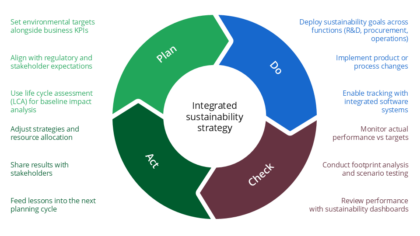
Integrate sustainability metrics into Plan-Do-Check-Act (PDCA) loops for continuous improvement
Target setting with purpose
Specific, fact-based, measurable targets that are linked to business outcomes – are the ones that drive change. With a strong data foundation, teams can set clear baselines for impact across product lines, regions, and business units, prioritize improvements where they matter most, and monitor progress with confidence based on robust historical data.
High-quality, up-to-date and cross-functional data enables targets to move beyond aspirations. They become operational touchpoints that teams can confidently act on. And when sustainability targets are part of business-as-usual planning cycles, accountability follows naturally.
The role of life cycle assessment (LCA)
LCA provides the granularity and rigor needed in the underlying metrics to inform strategic targets. It enables:
- Hotspot analysis to guide resource allocation
- Scenario modelling to evaluate design or sourcing changes
- Transparent reporting that supports both compliance and decision-making
In other words, LCA builds the essential data backbone for sustainable business management. Used well, LCA shifts sustainability from reporting burden to strategic advantage.
Making sustainability actionable
Impact data should inform action, not overwhelm it. By grounding sustainability in management systems and actionable KPIs, companies can bridge the gap between knowing and doing. High-quality, transparent LCA data helps align strategy, operations, and finance. It empowers CSOs to guide change. It helps CFOs quantify exposure and ROI. And it gives CEOs the confidence to lead with a coherent, trusted strategy.
Because success isn’t about how much you report. It’s about what you do with the numbers to steer the business forward.
Want to make your sustainability metrics work harder?
Let’s explore how SimaPro cloud helps organizations move from data to direction.